How Crypto Casinos Work?
Introduction
Crypto casinos represent a structural shift in how online gambling platforms handle payments, verification, and player interaction. While the games themselves may resemble those found at traditional online casinos, the underlying systems operate on a different technological foundation. Instead of relying on banks, card networks, or centralized payment processors, crypto casinos use blockchain-based assets to facilitate transactions directly between the player and the platform.
Understanding how crypto casinos work requires looking beyond surface-level features such as faster withdrawals or anonymous accounts. At their core, these platforms combine digital wallets, blockchain transactions, and — in some cases — cryptographic verification systems to create an alternative gambling environment. This guide explains those mechanics in detail, focusing on how crypto casinos function in practice and what differentiates them from conventional online casinos.
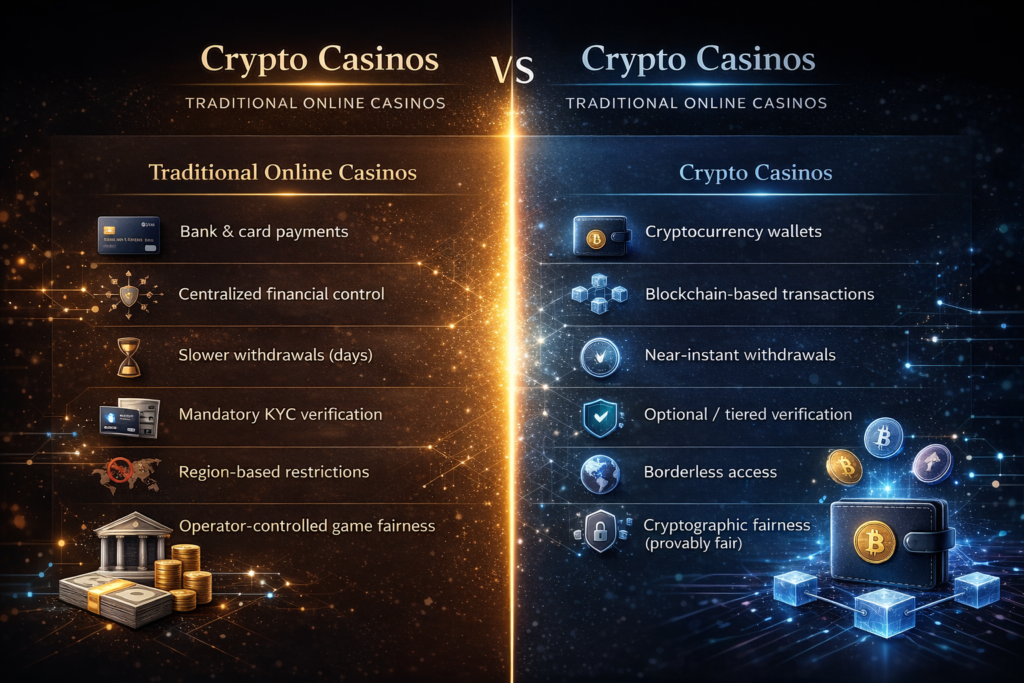
Structural Differences Between Crypto Casinos and Traditional Online Casinos
Traditional online casinos and crypto casinos may appear similar on the surface, offering comparable game libraries that include slots, table games, and live dealer experiences. However, the fundamental distinction between these platforms lies beneath the interface—within their financial infrastructure, transaction logic, and operational transparency.
Conventional online casinos rely on centralized banking systems and third-party payment processors. Deposits and withdrawals typically pass through banks or card networks, introducing intermediary fees, longer processing times, and strict identity verification requirements. These systems are also subject to regional regulations, which can restrict access based on a player’s geographic location.
Crypto casinos, by contrast, operate on decentralized blockchain networks. Funds are transferred directly between the player’s digital wallet and the casino, reducing reliance on intermediaries and significantly accelerating transaction settlement. This architectural shift alters not only payment speed, but also how control, transparency, and responsibility are distributed between the platform and the user.
Another defining difference is verification and privacy. While traditional casinos usually require full identity verification before withdrawals are processed, many crypto casinos apply flexible or tiered verification models. This approach appeals to players who prioritize privacy, though it also places greater responsibility on users to assess platform legitimacy and security standards independently.
Finally, crypto casinos often integrate cryptographic verification mechanisms—such as provably fair systems—that allow players to independently verify game outcomes. This level of mathematical transparency is rarely present in traditional online casinos and represents a structural evolution in how trust is established within digital gambling environments.
Cryptocurrency Payments and Wallet-Based Transactions
The most defining characteristic of a crypto casino is its payment infrastructure. Rather than depositing funds through credit cards or bank transfers, players interact with the casino using cryptocurrencies such as Bitcoin, Ethereum, or other digital assets. These funds are stored and transferred through crypto wallets, which function independently of traditional financial institutions.
When a player makes a deposit, they send cryptocurrency from their personal wallet to a wallet address provided by the casino. This transaction is recorded on the blockchain and, once confirmed, the balance is credited to the player’s casino account. Withdrawals follow the same principle in reverse: funds are sent from the casino’s wallet back to the player’s wallet without intermediaries.
Because these transactions rely on blockchain networks, processing times are typically shorter than those associated with traditional banking systems. The absence of third-party payment processors also reduces friction, limits transaction rejections, and allows players to maintain greater control over their funds.